Five Questions with Glenn Clements
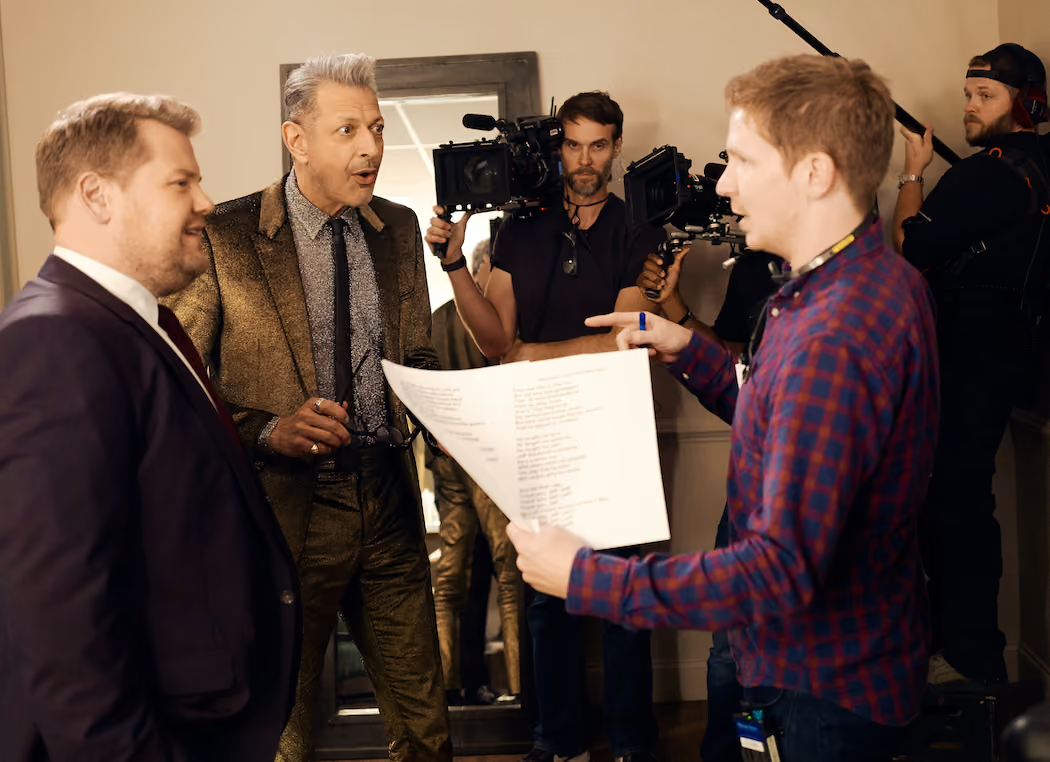
It’s time to get honest about the state of the industry. Michael Melamedoff chats with longtime friend and collaborator Glenn Clements (The Late Late Show With James Corden, The Daily Show) about short form storytelling versus long form, Glenn’s new vertical comedy series, and how data can help and hinder staying true to your comedy vision.
This interview has been condensed for length and clarity.
MICHAEL MELAMEDOFF: I am really excited to be with you here today, Glenn. For people who don’t know you: you’ve been working as a director across commercials and television for the better part of two decades – eight seasons on the Late Late Show with James Corden as their field director working segments like Carpool Karaoke, as well as shows like The Daily Show. Field directing and late night directing are such specific ways into the industry. How did you find your way into this part of your career?
GLENN CLEMENTS: Good question. There’s a long version and a short version. I’m gonna try to give you the medium version. Once I was out of college and looking at what opportunities I had in front of me, the options were essentially to scrape an indie film together, or work in TV. And working on TV seemed like a more immediate path to a creative role than indie film. So I was working on a prank show and started looking up the ladder. I saw that if I worked hard and proved myself, in a couple of years I could have an opportunity to write and direct for TV. And that turned into a job in the field department on Tough Crowd with Colin Quinn. It gave me a chance to cut my teeth – mostly producing and directing pieces – which allowed me to get a reel together. So when that show ended, I had some work samples that I could use to get me other jobs. About six months after Tough Crowd with Colin Quinn ended, I submitted to The Daily Show to be on their field team. It was the first submission I ever wrote. I wrote it in about a week, and I got the job. And it’s never been that easy since then.
[They both laugh]
But it was an incredible opportunity to join The Daily Show at the height of its success, and that was my way in – that sort of solidified my position in field departments on late night shows.
MELAMEDOFF: On some level certain things get easier, but it also truly never gets easier in our careers. How do you find the fortitude, the strength, the wisdom to continue trying? To continue pivoting, to continue trying to crack that code?
CLEMENTS: It’s the only option we all have. You and I are working on The Parents Life together – no one‘s making any money on it. It’s costing us money. But if you want to be a creative in this field, you need to continually show that you’re capable of creating quality things that people wanna watch. And if you’re not doing that, then that’s time wasted. So really whatever you have to do to continue that momentum is what you do.
MELAMEDOFF: Do you think all the work that you’ve done over the years in TV, specifically mid-form and short-form comedy, has changed or shifted your approach to storytelling in any way?
CLEMENTS: Yes. I think because of my experience, if I go too long without making an audience laugh, I start to feel like I’m not doing my job. [laughs] In all seriousness, all of my experiences have honed my ability to tell stories in short and medium forms. I can find the quickest route to the punchiest joke possible in everything I do, and that’s often what I’m called and asked to do. So in that sense, yeah.
MELAMEDOFF: Do you still look towards features? I know you said you sold a show to CBS early in your career... As you think about half hours and features and pieces that extend beyond the barriers of a three to five minute segment for late night, do you find yourself drawing on those short form techniques?
CLEMENTS: Absolutely. Storytelling is pretty similar in all forms. There are different attributes in a feature, things you can do in longer form that you couldn’t do in short form, but regardless of what the length of the project is, you always need to keep an audience engaged and entertained. So whether it’s two minutes or two hundred minutes, I think the aim is essentially the same – to entertain an audience, keep them watching, keep them thinking, and in my case hopefully keep laughing too.
MELAMEDOFF: You’ve done so much incredible work in late night: Carpool Karaoke alone was a decade-long, cultural sensation. At the same time, late night is a form and a format that feels – despite its cultural dominance for 70 years – like it’s vanishing in front of us. We’ve seen Colbert go off the air, we’ve seen Corden go off the air… There’s so many questions right now about what the future holds for Kimmel and Fallon, and The Daily Show. Do you have any thoughts on what’s going to become of late night? Or the ways that late night might continue to exist beyond traditional TV?
CLEMENTS: I have certainly felt this for about 10 years, and I’m sure other people have as well. With Twitter – now X – Instagram, TikTok… you see the jokes on late night hours before these shows air. So I think it’s really just migrating to social media. When Twitter was big like five, 10 years ago, you’d see most of the jokes from the monologues on Twitter hours before they were broadcast. I think topical comedy that you enjoy on late night, you will still find – it will just be in another format and another venue.
MELAMEDOFF: Speaking of social media, in the last few months you launched a TikTok and Instagram native social series called The Parents Life, which we are collaborating with you and your co-creator Spence Porter on. Can you tell me a little bit about the show, how it came to be, and what you’re hoping to accomplish with it?
CLEMENTS: The inspiration for the show came in early 2025. Like many people in the entertainment business, we were told “survive until ‘25.” And then [20]25 came and there was no bottle of champagne and bouquet of flowers. So I realized that the only way forward was to create something with a close circle of friends. I called up Spencer Porter who I’ve known for a long time and we came up with The Parents Life together. And then we brought it to Cowboy Bear Ninja – who we couldn’t have dreamt of a better partner on this – their commitment, resourcefulness, and frankly sacrifice to get this project made has been beyond our wildest expectations. Cowboy Bear Ninja’s ability to execute productions at both high budget and, in our case, low budget levels is very apparent to me. I see the work that you do on the high budget stuff and it’s brilliant. And I think the work that you’ve done with us is equally as brilliant even though we’ve made this project for no money.
MELAMEDOFF: Truly one of the things that I’ve enjoyed so much through our process so far is watching you and Spencer continue to evolve your approach to telling the story and refine that approach both in the service of what’s funniest, but to what you were saying earlier – I see you taking really seriously all the analytics that are coming in from TikTok and IG and using it to really think about how you meet your audience where they are in the format they’re watching you. Which I think is so critical.
You’ve got this incredible background in television as does Spencer who has been a writer on beloved series like Family Guy. Talk to me a little bit about merging both the experience and professionalism that comes from your time across network shows, working with huge celebrities – Tom Cruise, Ariana Grande, Seth MacFarlane – while still meeting the immediacy of social storytelling and its rising stars like Olivia DeLaurentis who stars in your show.
CLEMENTS: First, the analytics you get in social media are unparalleled compared to TV. It is crazy how you can essentially see how viewers respond to your videos in real time, and that feedback has helped us become better digital creators. Social media is a very different format than TV, and that data really helps us hone our episodes. The process of making The Parents Life has been a revelation for me. We shoot it with five crew members and two actors which is vastly different from my experiences on network television. So it’s just a really fun, small, flexible production and I’ve enjoyed making this show as much as I’ve enjoyed making anything in my career. It’s a real privilege to get to work with so many people I’m friends with.
MELAMEDOFF: That’s awesome. As you continue to push forward with new episodes of The Parents Life, are there boundaries that you wanna push based on what you’re learning from the analytics? Because of what you’re seeing in the data, are there things in the story that you’ll experiment with that we can look forward to?
CLEMENTS: I feel like this question applies to TV as well – there’s always a conflict between what will get the audience reaction, and what you want to create. We set out to make something that is grounded and relatable, and we’re often tempted to go broad or sketchy. The data sometimes pushes us to go in that direction, but that’s not what we set out to do. So we are very focused on finding ways to stay true to the mission that we set out, but also be flexible enough to vary what we’re doing to find an audience that’s big enough to sustain it. What we’re aiming to do with the next round of episodes is to tell stories that take place over multiple episodes. We think that’ll give us an opportunity to show a bit more heart, and to have the audience connect with our characters a bit more. So we’re excited about trying that and seeing if we can build the show in that direction.
MELAMEDOFF: I cannot wait to see the next batch of scripts. As somebody who has been following and is really intrigued by the growth of vertical dramas, I think it’s just a matter of time until serialized vertical comedy is a thing. So I’m really excited to see what’s next and we’re thrilled to be working with you guys on this.
CLEMENTS: Awesome, thank you buddy!
MELAMEDOFF: Thanks, Glenn.


